
 Colombia
 México
 Italia
 Francia
 Alemania
💪 Leg Exercises at Home: A Practical Guide to Strengthen Your Body Without Complications
The Challenge of Staying Active in a Sedentary World
Today, the modern pace of life has pushed us to spend long hours in front of a screen. Whether due to remote work or daily responsibilities, sedentary behavior has become a silent companion that affects our energy, posture, and long-term health. Many people feel that to improve their fitness, they need to sign up for an expensive gym or dedicate hours to exhausting workouts. However, the reality is much simpler and more accessible: you can transform your well-being by starting with your foundations, literally.
Doing leg exercises at home is not just about aesthetics. The lower body supports all our weight, facilitates mobility, and is the main engine of our metabolism. Activating these muscles does not require complex machines or heavy weights; you only need a small space, consistency, and the desire to feel better in your own skin.
Why Focus on Leg Training?
The legs house the largest muscle groups in our body, such as the quadriceps, glutes, and hamstrings. When we work these muscles, we are not only strengthening our limbs but also sending an activation signal to our entire system. A strong lower body improves balance, reduces the risk of lower back pain, and increases our ability to perform daily activities, such as climbing stairs or carrying groceries, without fatigue.
The real problem is not the lack of equipment, but the lack of a sustainable plan. Often, we try overly advanced routines that end up demotivating us. The key to success in physical well-being lies in simplicity and the ability to integrate movement as a natural habit, not as a heavy obligation.
Benefits of an Easy, Equipment-Free Routine
- Total Accessibility: You can train at any time, eliminating the barrier of travel time.
- Lower Joint Impact: By working with your own body weight, you learn to control your movements and protect your knees and ankles.
- Improved Circulation: Activating the legs helps venous return, reducing the feeling of heaviness at the end of the day.
- Sustainability: It’s easier to maintain a habit that only requires 20 minutes of your time in your living room.
Key Exercises to Activate Your Legs Today
For a leg workout to be effective, it must focus on functional movements. Here are the basic pillars that anyone can perform, adapting them to their own energy level.
1. Squats: The King of Movements
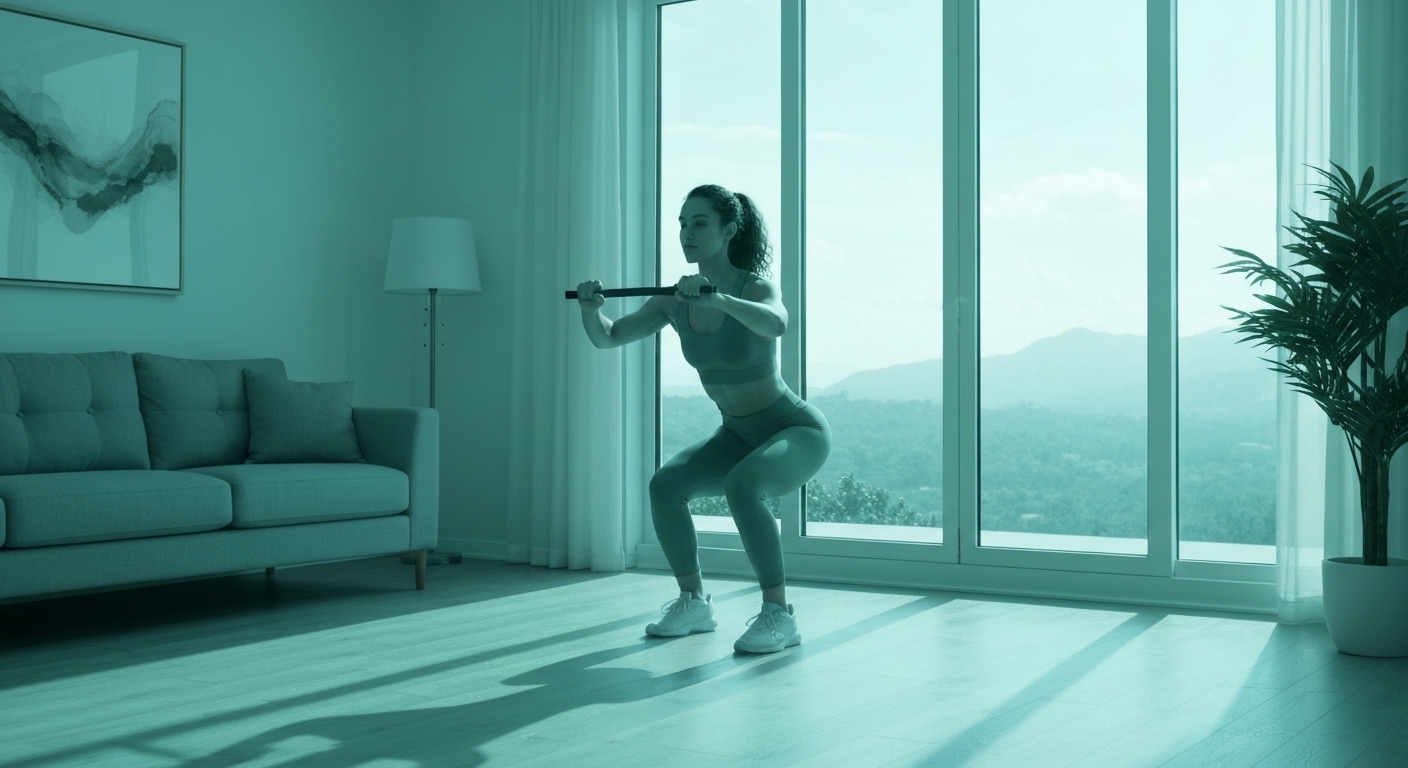
The squat is the quintessential functional exercise. It simulates the act of sitting down and getting up from a chair. To do it correctly, keep your feet shoulder-width apart, lower your hips as if looking for an invisible seat, and keep your chest upright. It is not necessary to go all the way down; the important thing is to maintain control and feel the effort in your thighs and glutes.
2. Lunges
This exercise is excellent for working on balance. Step forward and lower your back knee towards the ground, forming a 90-degree angle with both legs. If you feel unstable, you can lightly support yourself against a wall or a chair. Lunges are ideal for strengthening each leg individually, correcting natural imbalances.
3. Glute Bridge
Lie on your back with your knees bent, lift your pelvis towards the ceiling while squeezing your glutes at the top. This movement is essential to counteract the effects of sitting for long hours, as it activates the posterior chain and releases tension in the lower back.
Practical Routine to Start Today
This routine is designed to last approximately 20 minutes. It is ideal for beginners and requires no additional equipment. Remember to listen to your body and rest if needed.
Phase 1: Warm-Up (5 minutes)
- Joint Mobility: Gentle circles with your ankles and knees.
- March in Place: Walk in place while slightly raising your knees for 2 minutes.
- Dynamic Stretches: Gentle leg swings forward and backward.
Phase 2: Main Activity (12-15 minutes)
Perform 3 sets of the following circuit, resting 45 seconds between each exercise:
- Controlled Squats: 12 repetitions. Focus on your breathing.
- Alternating Lunges: 10 repetitions per leg. Keep your torso upright.
- Glute Bridge: 15 repetitions. Hold the position at the top for 2 seconds.
- Heel Raises: 15 repetitions (to work the calves). You can support yourself against a wall.
Phase 3: Cool Down (3-5 minutes)
- Quadriceps Stretch: Hold your foot behind you while leaning against a wall.
- Hamstring Stretch: With one leg extended in front, gently lean your torso forward.
- Deep Breaths: Inhale through your nose and exhale through your mouth to normalize your heart rate.
Tips to Maintain Consistency
The biggest mistake is trying to be perfect from day one. Well-being is a marathon, not a sprint. If one day you only have 5 minutes, do a set of squats. The important thing is not to break the habit chain. Also, try to associate your leg exercises at home routine with something you already do, like listening to your favorite podcast or just before your morning shower.
Don’t look for magical transformations in a week. Appreciate the small victories: feeling more energetic when climbing stairs, noticing less tension in your back, or simply the pride of having dedicated time for yourself.
Explore more health tips in our articles on healthy habits, discover how to improve your mental balance, or learn new ways of mindful eating to complement your physical activity.
Frequently Asked Questions (FAQ)
Is it possible to gain strength doing leg exercises at home without weights?
Yes, body weight is sufficient to generate resistance, especially at beginner and intermediate levels. The key is in the technique and progressively increasing repetitions or decreasing rest times.
How many times a week should I do this routine?
To see benefits in your overall well-being, it is recommended to do it 2 to 3 times a week, leaving at least one day of rest between sessions to allow for muscle recovery.
What should I do if my knees hurt when doing squats?
Make sure your knees do not excessively pass the tips of your toes and that your weight is on your heels. If the pain persists, reduce the range of motion or consult a professional to adjust your technique.
Activa tu bienestar hoy
Empieza con una rutina sencilla y construye el hábito paso a paso.